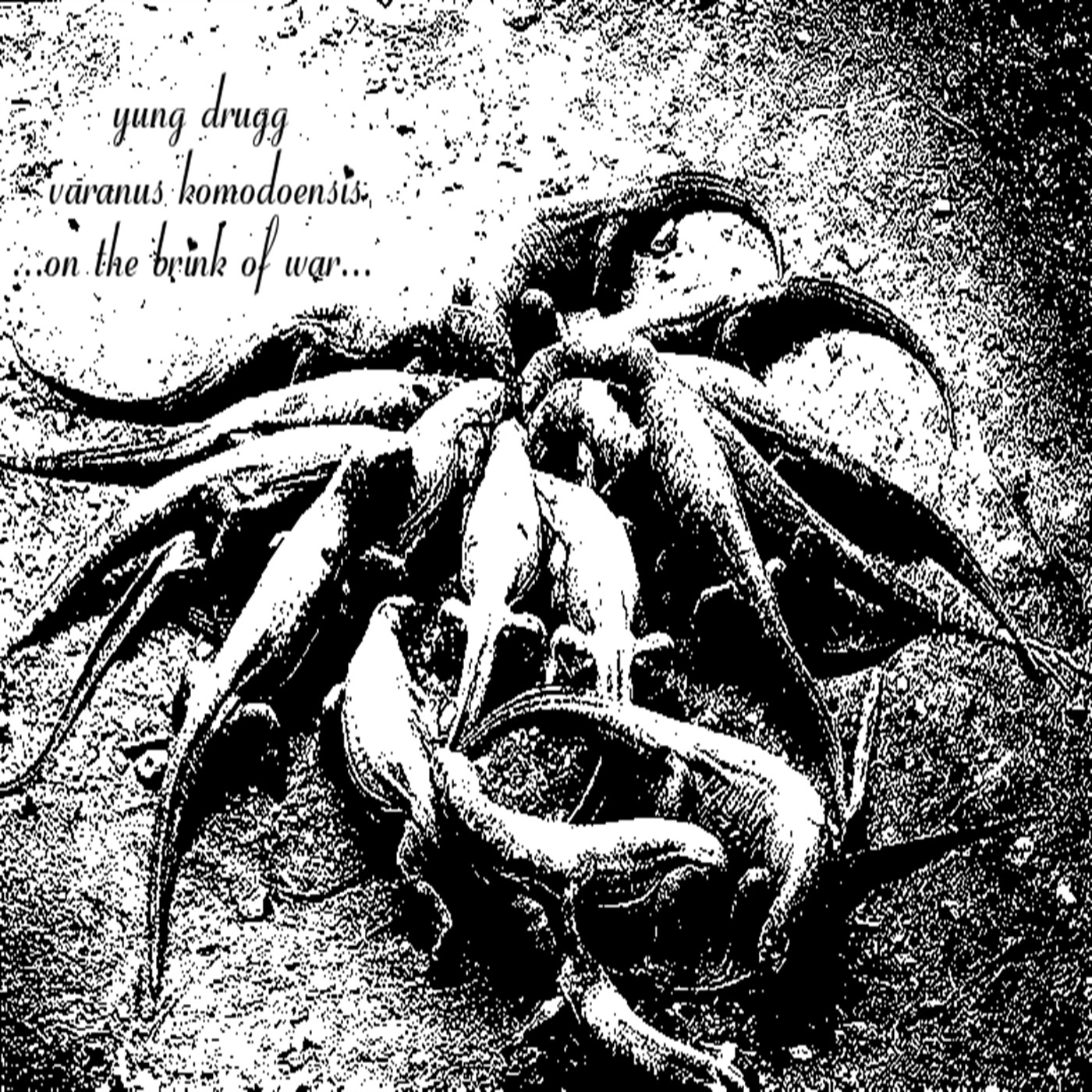
Varanus by Yung Drugg
https://www.smithsonianmag.com/science-nature/the-most-infamous-komodo-dragon-attacks-of-the-past-10-years-5831048/
https://abcnews.go.com/Technology/story?id=7681841&page=1
https://www.mnn.com/earth-matters/animals/stories/surprising-facts-about-komodo-dragons
https://www.britannica.com/animal/Komodo-dragon
https://www.nationalgeographic.com/science/phenomena/2013/06/27/the-myth-of-the-komodo-dragons-dirty-mouth/
Mr. Safina, a local guide working at Komodo National Park, took a particular relish in describing the way a Komodo dragon’s strong jaws can snap a man’s leg in two. He’d lived on Rinca – a speck of land off Indonesia’s Flores Island, and one of the five places Komodo dragons reside – his whole life, and he was used to the various horror stories that surfaced every now and then after a tourist wandered off the trail or a kid got ambushed while playing in the bush. Standing in front of an assembly line of water buffalo, deer and wild horse skulls – dragon chow – Mr. Safina laughed while gesturing to a row of little wooden crosses stuck in the nearby mud. On each stick, a date and a foreigner’s name was scrawled in white paint. “Those are tourist graves!” Mr. Safina joked. “No really, they’re actually just baby mangrove markers that tourists bought to restore the forest. Now, are you ready to go see the dragons?”
Like so many other tourists, for me, a trip to Indonesia was not complete without a detour to see the world’s largest lizard in its natural habitat. (Read Brendan Borell’s dispatch from his trip to Komodo Island, as featured in our special “Evotourism” issue of Smithsonian magazine.) In recent years, visitors have increasingly flooded this corner of Indonesia, drawn in by the thrill of brushing close to something wild and dangerous. Dragons are not to be taken lightly: male lizards can grow up to 10 feet long, weigh 150 pounds and eat up to 80 percent of their own body weight in one sitting. Though attacks are exceptionally rare, they do occasionally occur, mostly when a park guard lets his focus slip for a moment, or a villager has a particularly unlucky day.
Komodo dragons have shark-like teeth and poisonous venom that can kill a person within hours of a bite. Yet villagers who have lived for generations alongside the world's largest lizard were not afraid — until the dragons started to attack.
The stories spread quickly across this smattering of tropical islands in southeastern Indonesia, the only place the endangered reptiles can still be found in the wild: Two people were killed since 2007 — a young boy and a fisherman — and others were badly wounded after being charged unprovoked.
Komodo dragon attacks are still rare, experts note. But fear is swirling through the fishing villages, along with questions on how best to live with the dragons in the future.
Main, a 46-year-old park ranger, was doing paperwork when a dragon slithered up the stairs of his wooden hut in Komodo National Park and went for his ankles dangling beneath the desk. When the ranger tried to pry open the beast's powerful jaws, it locked its teeth into his hand.
"I thought I wouldn't survive... I've spent half my life working with Komodos and have never seen anything like it," said Main, pointing to his jagged gashes, sewn up with 55 stitches and still swollen three months later. "Luckily, my friends heard my screams and got me to hospital in time."
Komodos, which are popular zoo exhibits from the United States to Europe, grow to be 10 feet (3 meters) long and 150 pounds (70 kilograms). All of the estimated 2,500 left in the wild can be found within the 700-square-mile (1,810-square-kilometer) Komodo National Park, mostly on its two largest islands, Komodo and Rinca. The lizards on neighboring Padar were wiped out in the 1980s when hunters killed their main prey, deer.
Though poaching is illegal, the sheer size of the park — and a shortage of rangers — makes it almost impossible to patrol, said Heru Rudiharto, a biologist and reptile expert. Villagers say the dragons are hungry and more aggressive toward humans because their food is being poached, though park officials are quick to disagree.
The giant lizards have always been dangerous, said Rudiharto. However tame they may appear, lounging beneath trees and gazing at the sea from white-sand beaches, they are fast, strong and deadly.
The animals are believed to have descended from a larger lizard on Indonesia's main island Java or Australia around 30,000 years ago. They can reach speeds of up to 18 miles (nearly 30 kilometers) per hour, their legs winding around their low, square shoulders like egg beaters.
When they catch their prey, they carry out a frenzied biting spree that releases venom, according to a new study this month in the journal Proceedings of the National Academy of Sciences. The authors, who used surgically excised glands from a terminally ill dragon at the Singapore Zoo, dismissed the theory that prey die from blood poisoning caused by toxic bacteria in the lizard's mouth.
"The long, jaded teeth are the primary weapons. They deliver these deep, deep wounds," said Bryan Fry of the University of Melbourne. "But the venom keeps it bleeding and further lowers the blood pressure, thus bringing the animal closer to unconsciousness."
Four people have been killed in the last 35 years (2009, 2007, 2000 and 1974) and at least eight injured in just over a decade. But park officials say these numbers aren't overly alarming given the steady stream of tourists and the 4,000 people who live in their midst.
"Any time there's an attack, it gets a lot of attention," Rudiharto said. "But that's just because this lizard is exotic, archaic, and can't be found anywhere but here."
Still, the recent attacks couldn't have come at a worse time.
The government is campaigning hard to get the park onto a new list of the Seven Wonders of Nature — a long shot, but an attempt to at least raise awareness. The park's rugged hills and savannahs are home to orange-footed scrub fowl, wild boar and small wild horses, and the surrounding coral reefs and bays harbor more than a dozen whale species, dolphins and sea turtles.
Claudio Ciofi, who works at the Department of Animal Biology and Genetics at the University of Florence in Italy, said if komodos are hungry, they may be attracted to villages by the smell of drying fish and cooking, and "encounters can become more frequent."
Villagers wish they knew the answer.
They say they've always lived peacefully with Komodos. A popular traditional legend tells of a man who once married a dragon "princess." Their twins, a human boy, Gerong, and a lizard girl, Orah, were separated at birth.
When Gerong grew up, the story goes, he met a fierce-looking beast in the forest. But just as he was about to spear it, his mother appeared, revealing to him that the two were brother and sister.
"How could the dragons get so aggressive?" Hajj Amin, 51, taking long slow drags off his clove cigarettes, as other village elders gathering beneath a wooden house on stilts nodded. Several dragons lingered nearby, drawn by the rancid smell of fish drying on bamboo mats beneath the blazing sun. Also strolling by were dozens of goats and chickens.
"They never used to attack us when we walked alone in the forest, or attack our children," Amin said. "We're all really worried about this."
The dragons eat 80% of their weight and then go without food for several weeks. Amin and others say the dragons are hungry partly because of a 1994 policy that prohibits villagers from feeding them.
"We used to give them the bones and skin of deer," said the fisherman.
Villagers recently sought permission to feed wild boar to the Komodos several times a year, but park officials say that won't happen.
"If we let people feed them, they will just get lazy and lose their ability to hunt," said Jeri Imansyah, another reptile expert. "One day, that will kill them. "
The attack that first put villagers on alert occurred two years ago, when 8-year-old Mansyur was mauled to death while defecating in the bushes behind his wooden hut.
People have since asked for a 6-foot-high (2-meter) concrete wall to be built around their villages, but that idea, too, has been rejected. The head of the park, Tamen Sitorus, said: "It's a strange request. You can't build a fence like that inside a national park!"
Residents have made a makeshift barrier out of trees and broken branches, but they complain it's too easy for the animals to break through.
"We're so afraid now," said 11-year-old Riswan, recalling how just a few weeks ago students screamed when they spotted one of the giant lizards in a dusty field behind their school. "We thought it was going to get into our classroom. Eventually we were able to chase it up a hill by throwing rocks and yelling 'Hoohh Hoohh."'
Then, just two months ago, 31-year-old fisherman Muhamad Anwar was killed when he stepped on a lizard in the grass as he was heading to a field to pick fruit from a sugar tree.
Even park rangers are nervous.
Gone are the days of goofing around with the lizards, poking their tails, hugging their backs and running in front of them, pretending they're being chased, said Muhamad Saleh, who has worked with the animals since 1987.
"Not any more," he says, carrying a 6-foot-long (2-meter) stick wherever he goes for protection. Then, repeating a famous line by Indonesia's most renowned poet, he adds: "I want to live for another thousand of years."
1. Komodo dragons are originally from Australia
While famous for being from the Indonesian island of Komodo and surrounding islands, the Komodo dragon started off in the Land Down Under. According to fossil records, Komodo dragons moved out of Australia and made their way to the Indonesian islands, arriving on the island of Flores around 900,000 years ago. LiveScience explains how this worked out:
"In the past, researchers had suggested the Komodo dragon (Varanus komodoensis) developed from a smaller ancestor isolated on the Indonesian islands, evolving its large size as a response to lack of competition from other predators or as a specialist hunter of pygmy elephants known as Stegodon.
However, over the past three years, an international team of scientists unearthed numerous fossils from eastern Australia dated from 300,000 years ago to roughly 4 million years ago that they now know belong to the Komodo dragon.
"When we compared these fossils to the bones of present-day Komodo dragons, they were identical," said researcher Scott Hocknull, a vertebrate paleontologist at the Queensland Museum in Australia. 'Now we can say Australia was also the birthplace of the three-meter (10 foot) Komodo dragon,' Hocknull said."
Palaeontology professor Tim Flannery of Macquarie University in Sydney notes that the Komodo dragon may have disappeared from Australia around 50,000 years ago, a disappearance that coincides with the arrival of humans to the continent. It also has disappeared from all but a few isolated islands, and the species is now considered vulnerable to extinction.
Tracklist
| 1. | Komodo Warfare(prod. Krissio/Drugg) | 1:41 |
| 2. | Exanthematicus(prod. lucid soundz) | 3:46 |
| 3. | Komodoensis(prod. Rareflower) | 4:10 |
Credits
Credits: Yung Drugg, Lucid soundz, Rareflower, Krissio
License
All rights reserved.Recommendations





#TRAPGRUNGE
Started 2015 In Oly,WA and lived/created in PDX, SD, Eugene, Chicago..., released 200+ albums 2015-2020. Acacia Komodo now. previously in many projects including Skomm, Wolfrunner, Al Bundy, The Velisha, The Horse. + hella more.
Acacia Komodo.
Komodo Music Group.
acaciakomodo.bandcamp.com
soundcloud.com/yungdrugg
soundcloud.com/acaciakomodo
QUEER LIBERATION. Grow plants, too.