set11-90 by .
Pranayama: A Comprehensive Exploration of Breath, Consciousness, and Well-being
Executive Summary
Pranayama, a foundational practice within yogic traditions, represents far more than simple breathing exercises. It is a sophisticated discipline centered on the conscious regulation of vital life energies through breath control. Rooted in ancient Indian philosophy and meticulously detailed in classical texts like Patanjali's Yoga Sutras, Pranayama aims to foster profound physical, mental, and spiritual well-being. This report delves into its etymological origins, historical development, core objectives, key techniques, and the claimed benefits, integrating traditional understanding with contemporary scientific perspectives. It underscores the critical importance of informed and guided practice to harness its full potential and ensure safety. By exploring the intricate relationship between breath and consciousness, Pranayama stands as a powerful tool for holistic health and personal transformation.
1. Introduction to Pranayama: The Science and Philosophy of Breath
1.1. Definition and Etymology: Deconstructing "Prana" and "Ayama"
Pranayama is fundamentally defined as the yogic practice of focusing on and regulating breath, extending beyond mere physical respiration to encompass a deeper control over vital life energies.1 This ancient Sanskrit compound is derived from two distinct yet interconnected words: "Prana" and "Ayama".1
The term "Prana" refers to breath, but its meaning is far more expansive, signifying "life force" or "vital principle".1 In yogic philosophy, Prana is understood as a subtle life force energy that permeates all levels of reality, from living organisms to inanimate objects, and is considered essential for sustaining and animating life.4 Its etymology, combining "pra" (constant) and "ana" (movement), suggests a "continuous flow" of this vital energy.6 It is often conceptually paralleled with "Qi" in traditional Chinese medicine, representing the fundamental energy that drives all physiological and psychological processes.6
"Ayama" is commonly translated as "control" or "extension".1 However, a deeper linguistic analysis reveals additional meanings such as "suspension," "restrain," or "stopping".2 This multifaceted interpretation of "Ayama" is crucial. While the common understanding of breathing exercises often focuses on lengthening inhalations and exhalations, the inclusion of "stopping" directly references
Kumbhaka (breath retention), a core component of many Pranayama techniques. For advanced practitioners, the ultimate aim is the complete suspension of breathing, known as kevala kumbhaka, intended to "cause the mind to swoon".2 This indicates that Pranayama is not solely about enhancing respiratory capacity or flow but about achieving a state beyond ordinary physiological breathing, potentially leading to a temporary cessation of mental fluctuations and deeper states of consciousness. Thus, the synthesis of "Prana" and "Ayama" defines Pranayama as the sophisticated practice of regulating, controlling, or extending the life force through deliberate breath manipulation, aiming to influence not just the physical body but also the subtle energetic and mental dimensions of an individual.1
1.2. The Concept of Prana as Life Force and its Significance
Prana is understood as the fundamental "life force energy" that animates the body, mind, and spirit.6 It is considered the vital energy that sustains and supports every bodily function, including respiration, circulation, digestion, and even cognitive processes and thought activity.6 This concept transcends a purely physiological understanding of breath, positing Prana as a universal, subtle life force that integrates physical vitality with mental clarity and spiritual consciousness.4
In yogic philosophy, Prana is not limited to the physical breath or the oxygen inhaled; it is a subtle energy that flows throughout the body via specific energetic channels known as nadis, with concentrated vortexes of this energy referred to as chakras.6 This subtle body concept is distinct from the physical body but intimately connected to it. The balance and flow of Prana are believed to directly influence an individual's mental and emotional states.
Tracklist
Videos
Credits
A balanced flow of Prana is associated with mental clarity and calmness, while imbalances can manifest as nervousness, chronic fatigue, or mental blocks.6 The assertion that Prana "cannot be defined by modern scientific devices but only by being aware of it with the help of practices like pranayama and meditation" 6 suggests a different epistemological framework for understanding this energy. This framework is rooted in subjective, experiential awareness rather than solely objective, empirical measurement, signifying that Pranayama is designed to work at these deeper, less tangible levels, aiming for holistic integration. This holistic view implies that manipulating breath through Pranayama offers a direct pathway to influence not just bodily functions but also psychological states and spiritual awareness, bridging the gap between the tangible and intangible aspects of human existence.
2. Historical and Philosophical Foundations of Pranayama
2.1. Ancient Origins in Indian Spiritual Traditions (Vedic Texts, Oral Tradition)
Pranayama is an ancient practice with deep roots in the yogic traditions of India, with historical records of its practice dating back thousands of years.3 Its foundational principles can be traced to the Vedic texts, which are among the oldest scriptures globally, indicating its profound historical significance within Indian spirituality.3
Historically, the transmission of Pranayama techniques occurred predominantly through an oral tradition, passed directly from a qualified teacher (guru) to a dedicated student (disciple).3 This method emphasized experiential learning and the subtle nuances of the practice that are difficult to convey through written texts alone.3 The repeated emphasis on this oral tradition, despite the existence of ancient written texts like the Vedas, highlights a critical pedagogical and philosophical aspect of its practice. This is not merely a historical detail; it conveys that theoretical knowledge, while foundational, is inherently insufficient for true mastery and safe application of these subtle techniques. The "subtle and powerful nature" of Pranayama necessitates direct, personalized guidance to truly grasp its "wisdom and insight".3 This historical method underscores the importance of a living lineage, where the teacher can observe, correct, and adapt instructions to the individual student's needs. It also reveals the qualitative difference between intellectual understanding and embodied, experiential practice. This approach continues to be highly valued even today, despite the availability of written resources, ensuring the integrity, depth, and wisdom of the teachings were preserved and accurately transmitted across generations.3
2.2. Pranayama in Patanjali's Yoga Sutras: The Fourth Limb of Ashtanga Yoga
The core principles of classical yoga, including the practice of Pranayama, are primarily derived from the Yoga Sutras compiled by Sage Patanjali.1 This text serves as a foundational guide for many contemporary yoga practices. Within Patanjali's comprehensive framework of
Ashtanga Yoga (the eight limbs of yoga), Pranayama is designated as the fourth limb, as stated in verse 2.29 of the Yoga Sutras.2 This positioning indicates its crucial role in the progression towards higher yogic states, following ethical disciplines (Yama, Niyama) and physical postures (Asana).
While Patanjali outlines his specific approach to Pranayama in verses 2.49-2.51 and details the benefits of its practice in verses 2.52-2.53, he does not extensively elaborate on the intrinsic nature of Prana itself.2 This suggests that the theoretical understanding and practical application of Pranayama likely underwent significant development and elaboration in traditions that followed Patanjali's foundational work.2 The consistent citation of Patanjali's
Yoga Sutras as the primary text for classical yoga and Pranayama, coupled with the observation that Patanjali "does not fully elucidate the nature of prana" and that the "theory and practice of pranayama seem to have undergone significant development after him" 2, reveals a dynamic tradition. This highlights that while Patanjali provided the essential philosophical and structural framework for Pranayama as a limb of yoga, the practical techniques and the deeper theoretical understanding of Prana's intricate workings evolved considerably in subsequent traditions. This demonstrates a dynamic, rather than static, tradition where foundational principles are continually expanded upon through ongoing practice, experiential discovery, and the development of new methodologies, particularly within the Hatha Yoga lineage. Contemporary yoga teachers, such as B.K.S. Iyengar, continue to advocate that Pranayama should be integrated as part of a holistic yoga practice that includes the other limbs of Patanjali's Raja Yoga, particularly Yama (ethical restraints), Niyama (observances), and Asana (physical postures).2 This integrated approach emphasizes the ethical and physical preparation necessary for effective breath control.
2.3. Evolution and Development within Hatha Yoga
The Indian tradition of Hatha Yoga significantly advanced and systematized various Pranayama techniques.2 This lineage placed a strong emphasis on physical postures and breath control as a means to prepare the body and mind for deeper meditative states. Key texts from this tradition, such as the 15th-century
License
CC BY-SA 3.0. See the Creative Commons website for details.






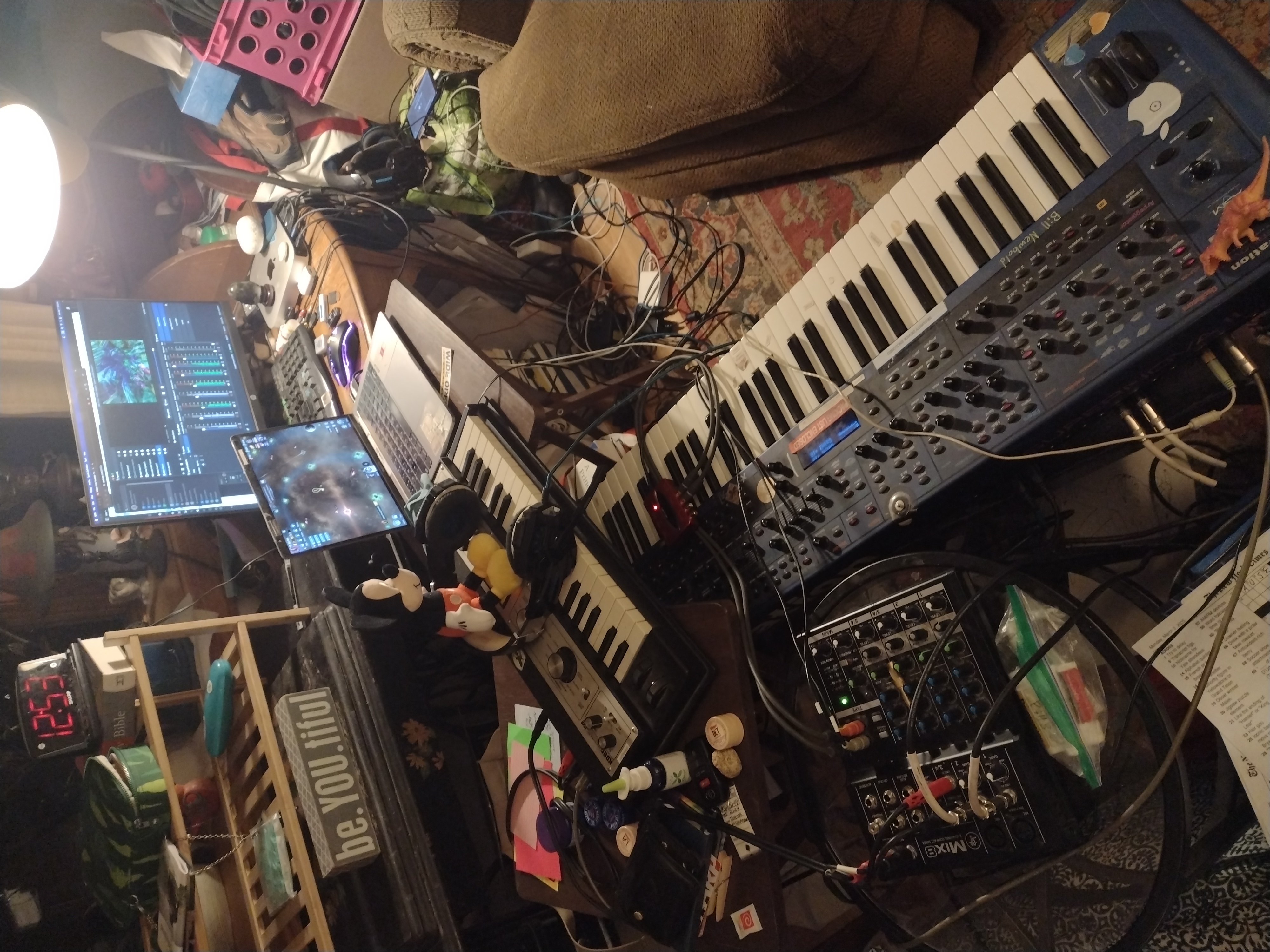
I make solo albums and videos without anyone's help here.(total creative freedom) I have been playing the supernova II by novation since 2000 mostly as often as I can. recording everything, I have worked with the presets repro-gramming over 1/2 of the over 500 presets
YouTube
twitch.tv
patreon.com
existentialisticextremistexperiments.wordpress.com
Facebook