FYI by Simeon Flick
Americans sure do love their acronyms.
Sourcing origins to the exorbitantly funded US military, the all-caps shortening of phrases to appease decreased attention spans and convenience-addled complacency of progressively less educated denizens is now an inextricable part of the dumbing-down of English grammar. Very fitting and telling that a nation so primed for war has appropriated language modifications from the armed forces.
Some of the newer abbreviations leave many––especially the longer-toothed among us––a bit mystified as to their meaning, but there’s no mistaking the extrapolation of the singular, ubiquitous FYI: For Your Information, which was one of the first to embed itself in our colloquial vernacular. Implied meanings are myriad, but generally include full disclosure, edification, and warning, each of which could apply to one or another of the eight songs in this like-named thirteenth track cluster of music from San Diego solo artist Simeon Flick.
Dans Ta Visage––the previous group of original songs––was sonically and lyrically bellicose, while FYI mostly directs the reckoning inward with warmer timbres and subtle humor, highlighting and owning the virtues, quirks, and foibles of Flick’s multifaceted character with the usual lack of restraint or filter. And whereas Dans Ta Visage was more on the alternative side of Flick’s “Alternative R&B” spectrum, FYI leans back toward the middle of the hybrid, with more kinetically compelling beats to balance out the rock edge, as with Gung Ho Hum four records prior. And with the overt presence of the heretofore mostly absent acoustic guitar on two songs, perhaps there is a reintegration of Flick’s erstwhile folk explorations afoot. Also, thanks to crucial adjustments made in the recording process and in the choice of instruments, effects, and tones, and no matter what one may think of the underlying works or performances, this may be the best-sounding album in Flick’s burgeoning song catalog to date.
The opening acoustic power-pop groover “Inertia” incorporates metaphors from past indolence real and imagined in its urging the listener to put all of their available energy into achieving their personal goals, not an IV drip’s worth (“No minimum effort / For maximum gain / ‘Cause you cannot make motion / When you deny the energy it takes”).
“Flaw Of It All” finds Flick illustrating the absurdities of metastasized capitalism over a heavily syncopated beat in the sardonic first person, decrying the way it twists all thoughts exclusively towards the making of more money than we actually need to survive, and transmogrifies everyone other than our inner circle into competition (“How can I get the bread / I got to get the bread / ‘Cause if I don’t get the bread / Then the others get the bread / ‘Cause yacht boats ain’t cheap / And private jets ain’t cheap / And Jacuzzi bubbles ain’t cheap / So I got to get the bread”).
“Mastery” starts with an Asian-esque cascade of natural guitar harmonics, a likeminded sotto voce utterance in Japanese, and an onomatopoetic yawn (“Rising into my morning…”) before Flick riffs on a concept close to his heart––self-improvement––in a hip-hop monster chorus way as he mellow-flows through lines like, “…Then I continue my dogged pursuit of mastery / In all I do, I vie not with you but past me / How much more can I improve on the last me / Why are we even here if not to blast free / From all the baser limitations of humanity.”
“Just Passing Through” speaks to the introverted among us who feel accosted by an ever-louder world demanding a one-way flow of time, money, attention, and energy, sugarcoated with a classic mid-tempo, urban R&B feel and bolstered by a melodic bass line supporting lush, broad-swath passing chords (“Walking down Life Avenue / Wading through the retinue of leeches / Heed us, feed us, needy leer / Redirect-your-eyes-right-here beseeching / Everyone’s a gaping maw / I’m overwhelmed and overdrawn / So I abscond”).
“Over The Top” uses militaristic imagery––and recognizable sounds (the already thin figurative and grammatical line between martial and marital blurs even more with the occasional presence of a machine-gun- and march-alluding snare motif)––from World War I to describe the mutually assured penances and penitence of long-term relationships (“You sent me over the top / Saw better men than me drop / And yet insisted ‘all costs!’”).
“No Pride” is the anguished cry of a white, heterosexual male descendant of northern European immigrants for whom the weight of the shameful contemporary reckonings with Jim Crow racism, our slave-owning past, native American genocide and diaspora, misogynistic patriarchy, and all-purpose bigotry have become too much to bear despite the absence of first-person culpability (“No pride / No lie / In indigenous genocide / …I cry / For women raped and denied / …In this time / When Jim Crow just won’t die / No pride / Can’t hide / And it eats me up inside”).
“G.O.A.T.”, a more recent entry into the colloquial acronym sweepstakes, takes a rap rock dig at our obsessive propensity to rank the best in whatever field as though no one better will come along, and the respective author’s attempt to both shape and attach themselves to the perceived cachet of the often over-exaggerated legacy (“Greatest of all time is a phrase / Bandied about a lot these days / As if the greatest stay locked up in a parlor safe / Unassailable, the future also unavailable / There could be somebody better than Van Halen, who’s to say / When did subjective become objective and fact hearsay / Take G.O.A.T. lists from insular potentates / Not sure there’s enough of a takeaway / From watching others pass off personal favorites as something great”).
Album closer “When Love Goes” is a churning, Zeppelin-esque groove, borderline torch-song commentary on the perils of the disappearance of love, both on an individual and societal level (“Love feels so far away / Off on a holiday / Guzzling champagne in Saint Tropez / While sullen hearts hang in disarray / We pay a heavy toll / When love goes”).
A crisis era persists, and Flick is equally persistent in having that fact be widely acknowledged, albeit now with more humor and warmth to sugarcoat the jagged little pills. This record fits in with the rest of Flick’s output in the sense that these are unapologetic protest songs, both on a personal and universal level, and not only is he calling out conundrums but also offering solutions where he can, and with a wink and a grin whenever possible.
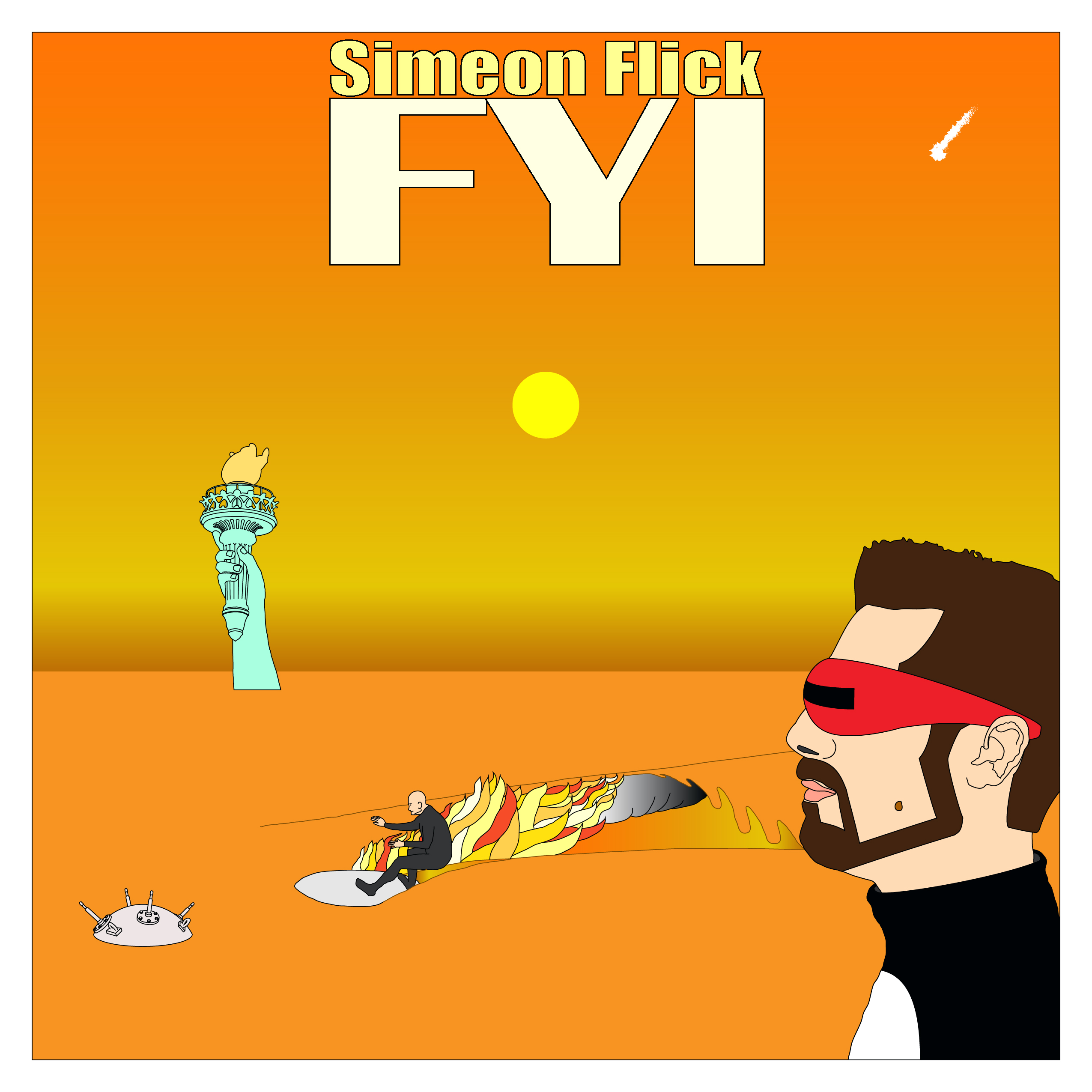
The cover art continues the cartoonish, symbol-laden visual ethos of past releases, presenting yet another multifaceted allegory rife with hilarious-as-it-is-potent imagery. Flick is seen in profile wearing the same “new wave” shades and aptly-colored turtleneck of Sparky, the perpetually dumbfounded and dismayed, voice-of-reason, I-told-you-so penguin from the Tom Tomorrow comic strip This Modern World, watching past, present, and future disasters––all but the latter manmade––unfold. Americans seem to stubbornly flout catastrophe like just another white-noise obstacle meant to be casually tolerated and overcome, and we seem to have a knack for creating these conundrums for ourselves while shunning the concomitant culpability; a surfer rooster-tails a wake of fire on a wave of lava, an easily avoidable collision with a naval mine imminent, the Statue of Liberty torch sticking up in the middle distance to bestow a chilling, Planet-Of-The-Apes-esque global positioning. To the upper right, a meteor falls on a collision course. Consider it all part of a comically disturbing postcard from an absurd––if not entirely possible––future.
FYI is now available at premium download and streaming outlets. File under alternative R&B prog-pop with a side order of hip-hop. Best enjoyed loudly and proudly.
Tracklist
| 1. | Inertia | 3:02 |
| 2. | Flaw Of It All | 4:09 |
| 3. | Mastery | 3:24 |
| 4. | Just Passing Through | 4:47 |
| 5. | Over The Top | 4:32 |
| 6. | No Pride | 3:22 |
| 7. | G.O.A.T. | 3:11 |
| 8. | When Love Goes | 5:51 |
Credits
Composed, arranged, programmed, performed, recorded, edited, mixed, and mastered by the Artist at Blue Chair Studio in La Mesa, CA. Cover art and design also by the Artist.
Thanks to: Allison Flick, Kathlyn Paxton, Matthew Stewart, Bill Ray, Nathaniel Flick, Fred Marotta (The Repair Zone), John Snead, David Napolitan, Ron Carmody, you.
License
All rights reserved.Tags








Simeon Flick is an independent San Diego-based heritage artist who specializes in Alternative R&B pop-rock music but dabbles in classical guitar on the side. His albums exhibit his prodigious, multi-instrumental musicality and poetic, confrontational, erudite, often humorous lyrics sung through his soulful vintage tenor. He owns and operates Blue Chair Studio in La Mesa, CA.