QUNTM INDCTN by Oliver Dodd
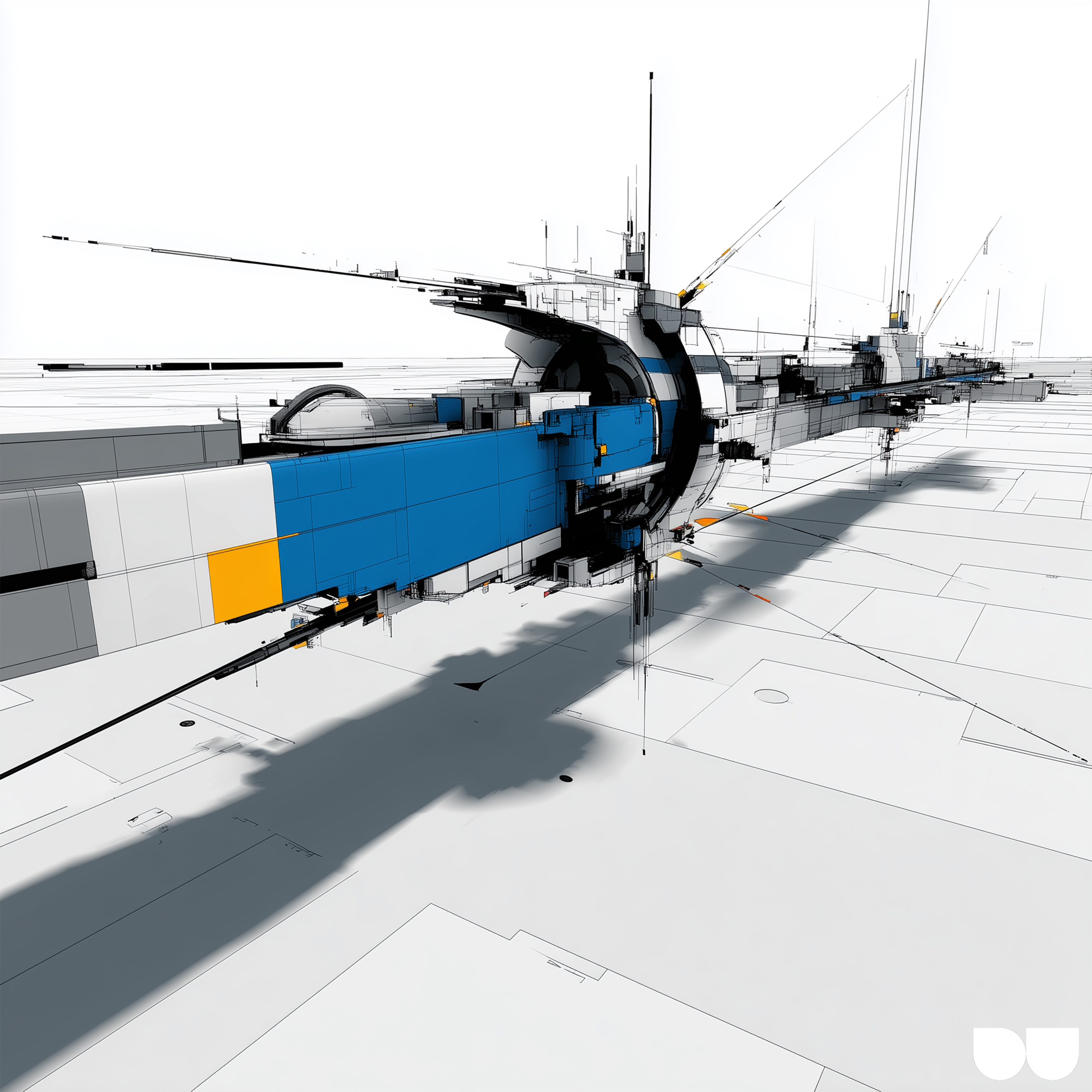
OLIVER DODD - QUNTM INDCTN
CAT# DETUND LTD 113
Quantum Induction: Emergent Structures in Complex Random Systems
Oliver Dodd – Konstructure Research Division, 2025
Abstract
Quantum Induction (QI) is proposed as a theoretical framework describing the emergence of order and structured behavior in dynamic random systems, spanning both physical and informational domains. QI explores how oscillatory energy, probabilistic states, and recursive feedback mechanisms interact to produce coherent, self-organizing structures. This paper investigates the mechanisms by which quantum states, coupled with systemic feedback, can generate emergent order, with implications for complex networks, artificial cognition, algorithmic sound design, and the modeling of self-organizing systems. The framework presented here bridges quantum physics, information theory, and cybernetic philosophy, offering a conceptual foundation for future experimental and computational studies.
1. Introduction
Induction has traditionally been understood as the generation of an electromotive force in response to a changing magnetic field. Extending this principle, Quantum Induction considers the induction of structured states across probabilistic systems—from the quantum scale to macroscopic networks.
At the heart of QI is the principle that energy or information need not act through direct contact to influence state transitions; resonant coupling and feedback propagation suffice to produce coherent order. Within this context, complex systems—whether physical, computational, or synthetic—can self-organize in ways that echo phenomena observed in quantum mechanics, fractal geometry, and information theory.
QI is therefore proposed as a unifying conceptual model for the study of emergent dynamics, bridging classical mechanics, thermodynamics, and cybernetic feedback processes.
2. Theoretical Foundations
● 2.1ResonantCouplinginQuantumFields
Quantum systems may interact without classical contact through overlapping eigenstates, leading to energy transfer across phase space. These resonant interactions produce constructive and destructive interference patterns, allowing energy to redistribute in ways that stabilize emergent structures.
● 2.2RecursiveFeedbackMechanisms
Self-organization requires that output from a system influence its own subsequent states. Recursive feedback loops amplify and refine stochastic fluctuations, enabling complex patterns to emerge from initially random conditions. This principle underpins both neural computation and algorithmic generative processes, providing a pathway from randomness to structured complexity.
● 2.3SpectralDistributionandEnergyPartitioning
Quantum Induction relies on the spectral partitioning of energy. Probability amplitudes propagate across eigenmodes, producing phase- dependent effects that modulate coherence and stability. In analog systems, these effects can be observed as harmonic resonance, interference patterns, or fractal temporal structures.
● 2.4Entropy,Order,andEmergence
Entropy is typically associated with disorder, yet in QI, controlled entropy becomes a vehicle for emergent order. Fluctuations in stochastic energy distributions can collapse into stable patterns, highlighting a dynamic interplay between disorder and structure. Entropic gradients provide the potential energy necessary for recursive induction and emergent coherence.
3. Conceptual Modeling
● 3.1Multi-ScaleDynamics
QI operates simultaneously across multiple scales. At the micro-level, probabilistic state transitions and quantum superposition generate uncertainty; at the macro-level, recursive coupling leads to measurable emergent phenomena. This interplay suggests that system-wide coherence can arise from local stochastic interactions, a principle mirrored in both natural and artificial networks.
● 3.2Information-TheoreticInterpretation
From an informational perspective, QI can be seen as a process of structure induction through feedback-mediated coding. Signals propagate through the system, self-modulate, and refine their own propagation paths. This process mirrors principles of error correction, neural plasticity, and emergent intelligence, providing a conceptual link between quantum systems and synthetic cognition.
● 3.3FractalandTopologicalStructures
Recursive propagation naturally gives rise to fractal structures, where self-similarity occurs at multiple levels of resolution. Topological mapping of these patterns allows for the visualization of emergent order within otherwise chaotic systems. QI predicts that these patterns are both stable and adaptive, capable of responding to perturbations while maintaining coherence.
4. Potential Applications
● 4.1ComputationalModelingofEmergence
QI provides a framework for simulating emergent behaviors in artificial neural networks, algorithmic generative systems, and cybernetic architectures. Recursive energy coupling can be modeled in software to study self-organizing phenomena in virtual environments.
● 4.2GenerativeSoundandMusicSystems
In sonically interpreted systems, QI principles inform the creation of dynamic textures and recursive harmonic structures, translating probabilistic resonance into perceptible auditory experience.
● 4.3SyntheticCognition
By applying recursive induction to computational systems, QI models provide a theoretical foundation for artificial awareness and self- referential processing, suggesting pathways for emergent intelligence in machine learning architectures.
● 4.4ComplexNetworkAnalysis
QI offers new insights into network topology and resilience, showing how feedback and resonant coupling can produce self-stabilizing behaviors in distributed systems, including social, ecological, and technological networks.
5. Discussion
Quantum Induction reframes traditional understanding of structure and order in complex systems. Rather than requiring direct interaction or pre-defined architecture, QI demonstrates that coherent structures can emerge spontaneously from stochastic energy distributions when mediated by resonance and feedback.
By unifying concepts from physics, computation, and cybernetics, QI provides a conceptual bridge between discrete micro-level phenomena and emergent macro-level structures. It emphasizes the role of time, phase, and recursive interaction in generating self-organization, offering a paradigm for both experimental study and creative application.
6. Conclusion
Quantum Induction presents a theoretical framework for understanding emergent behavior across scales, highlighting how resonance, feedback, and recursion can
generate coherent structures from stochastic foundations. Its principles extend from quantum physics to complex networks, computational modeling, and creative digital systems, suggesting profound implications for synthetic cognition, generative art, and emergent intelligence.
QI ultimately demonstrates that order can arise from chaos not by imposition but by resonance, and that self-organizing systems—natural or artificial—follow predictable yet adaptive pathways toward emergent complexity.
Tracklist
| 1. | FRCTL FRMWRK | 4:30 |
| 2. | MCHNCL VCTR | 3:37 |
| 3. | HRZN SNTX | 10:03 |
| 4. | KNMTC CHN | 4:03 |
| 5. | QRNTM DRFT | 7:54 |
| 6. | SPCTRL FBRC | 3:39 |
| 7. | LGRTHMC BLM | 7:44 |
| 8. | TPLGCL RCHTRCT | 4:41 |
| 9. | CGNTV FDBCK | 10:16 |
| 10. | PRCPTL LTT | 4:25 |
| 11. | CRCT NTRPY | 10:16 |