Fields by Harri Sjöström, Floros Floridis, Guilherme Rodrigues & Lawrence Casserley
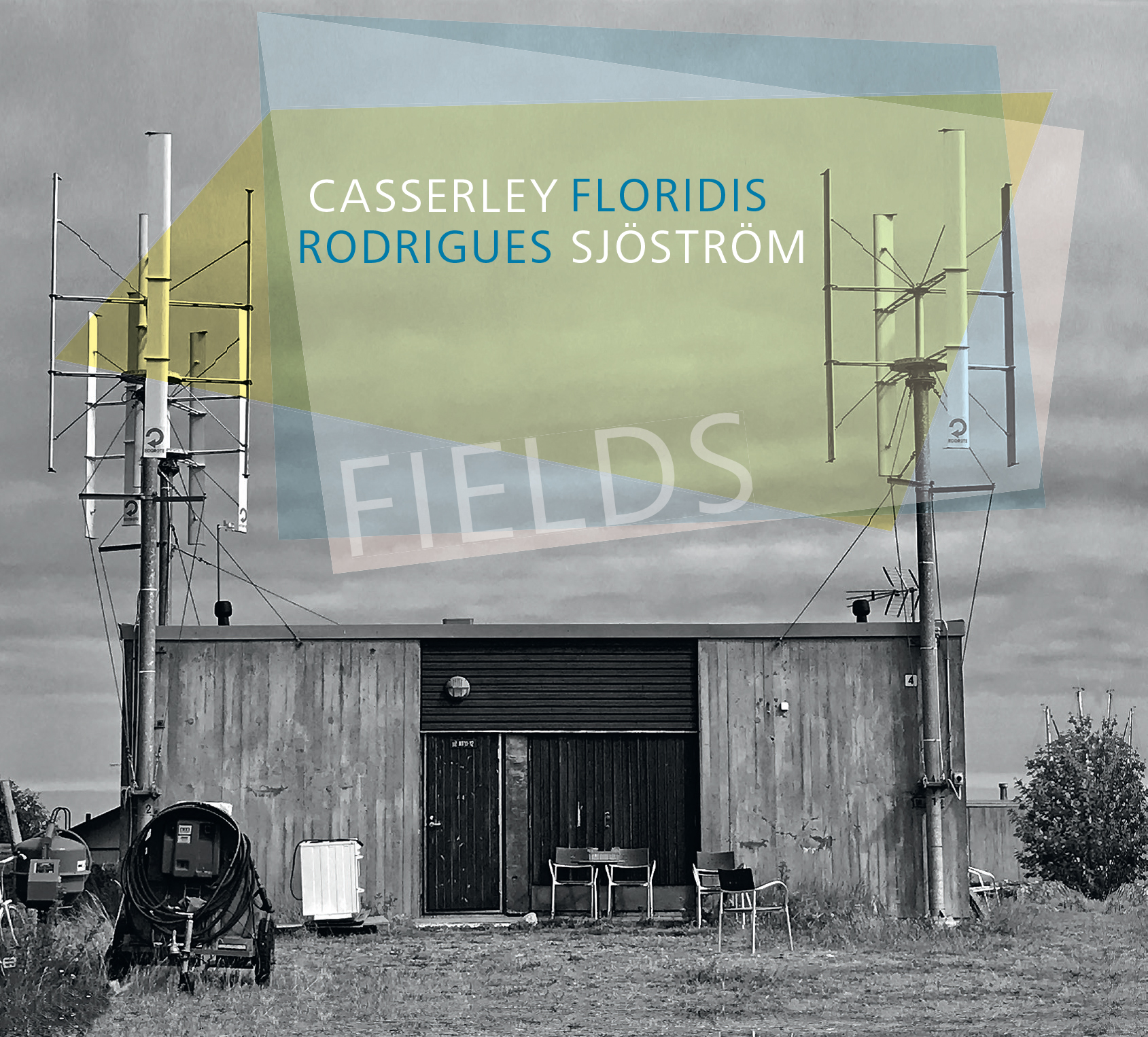
Recorded live in concert at Petersburg Art Space, Berlin on 9 March, 2022.
Recorded, mixed and mastered by Lawrence Casserley.
Graphic design by Andreas Wolf and Carlos Santos.
Photography by Harri Sjöström.
Production by Ernesto Rodrigues.
REVIEWS
Getting back to my usual daily activities here, although I still have various post-move chores pending, I do want to go ahead & note some thoughts (together in one entry) concerning a couple of new Creative Sources releases: The two programs aren't very related, although cellist Guilherme Rodrigues performs on both: He's continuing to branch out & record in different combos (including without Ernesto), and so I want to note first the intriguing electroacoustic textural explorations of (the generically titled) Fields, recorded in Berlin back in March 2022. For that outing, which can be a little thin or searching in some moments, Rodrigues is joined by a recent fixture in this space, Harri Sjöström — partly as a followup to the duo album the two recorded in 2018, The Treasures Are — as well as by Lawrence Casserley & Floris Floridis to forge a quartet. It turns out that I hadn't mentioned Floridis (here on clarinets) before, but Casserley first appeared in this space with the Valid Tractors trio (with Pat Thomas & Dominic Lash) & On the Validity of Tractors (reviewed February 2019), and then most recently with Resonant Voyaging (with Viv Corringham & Martin Hackett, reviewed August 2022): His personal development of a "signal processing instrument" has made him into a unique contributor. And then the textures on Fields are indeed reminiscent of other recent Sjöström outings, e.g. with Sergio Armaroli, and given the two-horn lineup here, especially their quartet outing with Giancarlo Schiaffini & Veli Kujala (as reviewed December 2022). And obviously I'm finding these explorations around Sjöström lately to be quite fertile.... With Fields, there're also the explicit electronic manipulations of Casserley, but some similar outcomes, most appealing perhaps when they project a kind of sparkling, twittering jungle vibe... but also leading into layered feels, shearing or bending... an abstract (sometimes metallic...) spaciness. (The twisting, spectral vibe can also evoke e.g. Dense Bushes with Delicate Chirps from Udo Schindler, as reviewed here last month, but there again acoustic & less spacey per se....) There's thus a naturalism, but also a sense of fracture — projecting an underlying sort of mystery or spectrality. And Casserley does continue to be underrecorded. Todd McComb's Jazz Thoughts
Deux Fields de 24:01 et 12:27 où l’élément prépondérant, celui qui détermine le plus les interactions et conditionne les modes de jeux et le Signal Processing Instrument de Lawrence Casserley. Cet ex-Professeur de Musique Électronique a quitté l’enseignement et son laboratoire de recherche pour mener à plein temps la vie d’improvisateur contemporain aux côtés de collègues de premier plan. Lawrence a fait partie de l’Electro-Acoustic Ensemble d’Evan Parker, partageant la scène avec Phil Wachsmann, Paul Lytton, Barry Guy, Adam Linson, Viv Corringham, Hans Karsten Raecke, Martin Mayes … Cela fait quelques années qu’il collabore avec le brillant saxophoniste soprano Finlandais, Harri Sjöström, comme le témoignent les albums Live at The Polnischen Versager Berlin (uniSono) et Soundscapes #3 avec une cohorte impressionnante d’improvisateurs (Fuudacja Sluchaj). Comme Sjöström avait aussi enregistré en duo avec le violoncelliste portugais Guilherme Rodrigues il y a quelques temps (The Treasures Are/ Creative Sources). Et tant qu’on y est, pourquoi pas inviter un quatrième larron, le très remarquable clarinettiste grec Floros Floridis, un musicien avec une très longues expérience et un feeling infaillible pour s’associer à différents groupes de la manière la plus cool qui soit. Floridis, Sjöström et Rodrigues résident à Berlin ce qui facilite bien des choses. On appréciera le travail intense des aigus – hyper aigus aux sax soprano et sopranino avec l’aide de sourdines dans le voisinage d’un Lol Coxhill. Guilherme Rodrigues révèle son sens de l’intervention ponctuelle en accord précis avec la situation au fil des improvisations. Floros Floridis est un savant doseur de souffles inspirés qui s’intègrent dans les changements évolutifs ou subis du paysage sonore. Captant sur le champ les sons de ses comparses, Lawrence Casserley réinjecte par ses haut-parleurs les extrapolations électro-acoustiques souvent inouïes de leurs improvisations par bribes et morceaux dont il altère ou transforme complètement la texture, les hauteurs de notes, la dynamique, la vitesse. Dans ce contexte musique de chambre aérienne, ces sons « procédés » circulent à pas de velours s’insinuant intelligemment dans les échanges. L’improvisation libre d’un troisième type. Il sollicite aussi chez ses camarades un autre type d’intervention spécifique au mode de fonctionnement en temps réel de ses applications complexes et surprenantes. Les instrumentistes se partagent entre la confrontation réactive et / ou additive ou le simple fait de confier au micro de l’installation de L.C. une sonorité qui va nourrir le processing pour apporter une nouvelle couleur, une idée imprévue projetant ainsi une autre perspective. La haute qualité sonore du travail de Casserley entraîne le quartet dans des perspectives et dimensions insoupçonnées, suspendues dans un espace mouvant parfois rétive à la gravitation, en lévitation oblique, nous faisant ressentir des perceptions peu communes. Jean-Michel Van Schouwburg (Orynx)
Kwartetowy front-line tworzą tu dwa dęciaki - ulotny, acz czupurny saksofon sopranowy (zamiennie z sopranino) i klarnet, na ogół basowy, preferujący zdystansowane riposty. Towarzyszy im frywolna wiolonczela, która zdaje się być pogrążona w estetyce chamber, ale gdy trzeba docisnąć struny, możemy na nią liczyć, a także wszędobylska elektronika, która na ogół czyni powinności live processing, ale zdolna jest też płynąć własnymi frazami i incydentalnie wyznaczać kierunek dalszej podróży. Fundamentem całego kwartetu w ujęciu dramaturgicznym jest potrzeba ciągłej zmiany. Każda akcja może tu liczyć na reakcję, a zasada ultra intensywnego słuchania i wchodzenia w dyskurs jest powinnością przypisaną bez wyjątku wszystkim.
Pierwsza improwizacja trwa ponad 24 minuty i konsumuje wszelkie walory dramaturgiczne dzieła wskazane w preambule. Głębokie wdechy i jeszcze głębsze wydechy budują gwałtowną powolność, syconą emocjami i chwilami ukradkowej nostalgii. Dęte frazy zdają się tu mieć niegraniczoną przestrzeń poruszania się, w ślad za nimi snuje się oniryczna elektronika, która potrafi kąsać, a instrumentem, który ma pieczę nad ładem i porządkiem narracji jest wiolonczela. Czujna, melodyjna, stabilizuje eko-system nerwowej improwizacji. Opowieść ma kilka punktów zwrotnych. Jeszcze przed upływem dziesiątej minuty muzycy odnajdują ciszę, sięgają po najdrobniejsze frazy. Akcje reanimują perkusjonalne wtręty wiolonczeli, mające wsparcie w zimnych podmuchach dętych i delikatnych plamach syntetyki. Po kolejnych pięciu minutach akcja osiąga stan wrzenia – wszyscy dygoczą z emocji, jedni formują się w strugę dronów, inni śpiewają post-barokiem wspartym na wyjątkowo nisko zawieszonym smyczku. Przed dłuższą chwilę opowieść balansuje od rozciągniętej w czasie ciszy po korpulentne fazy hałasu. Dramaturgiczny konsensus zostaje osiągnięty po dwudziestej minucie, gdy wszyscy lepią się w mroczny dron molowych medytacji. Za proces gaszenia płomienia odpowiada elektronika. Skwierczy, szmera, w końcu dosięga ciszy.
Druga improwizacja trwa dwanaście minut z sekundami. Jej początek jest ostry jak brzytwa. Saksofon i klarnet pokrzykują na siebie, wiolonczela śpiewa, a elektronika rozsiewa insekty kreatywności. Narracja intrygująco piętrzy się, po czym wpada w obcięcia kameralnej taneczności. Teraz zdarzyć się może już dokładnie wszystko – strunowe slajsy, dęte wdechy, frywolne zaczepki i krwiste riposty. Bywa, że na moment ktoś wychodzi przed szereg, ale dyktat kolektywności szybko przywołuje go do porządku. Jeszcze tylko kilka kocich westchnień i w okolicach dziesiątej minuty opowieść zaczyna układać się do snu. Przez moment można odnieść wrażenie, że czeka nas jeszcze finałowa kulminacja, ale to tylko pozór. Długie, leniwe frazy osiągają stan końcowej ciszy nie bez ingerencji edytorskiej. (Trybuna Muzyki Spontanicznej)
Credits
Harri Sjöström (FI) - Soprano & Sopranino Saxophones, Selected Mutes
Floris Floridis (GR) - Clarinets
Guilherme Rodrigues (PT) - Cello
Lawrence Casserley (GB) - Signal Processing Instrument
License
All rights reserved.Recommendations
 DUOT with STRINGS
by DUOT & ZARM Ensemble (Cirera/Prats/Zingaro/Alves/Mitzlaff/Rosso)
 Liminal Silence
by Sunny Kim, Vardan Ovsepian, Ben Monder
 METASTABILITY
by Ben Carey
 Recall the Dream Breath
by Post Moves & The Sound Memory Ensemble
 ETIDORHPA
by Vault of Blossomed Ropes
 42 Days 四十二天
by Southeast of Rain 东南有雨
 Songs of Hope for Gaza
by Pretty Purgatory

Creative Sources releases a plethora of improv/jazz and experimental electronic music.
Founded in 2000.