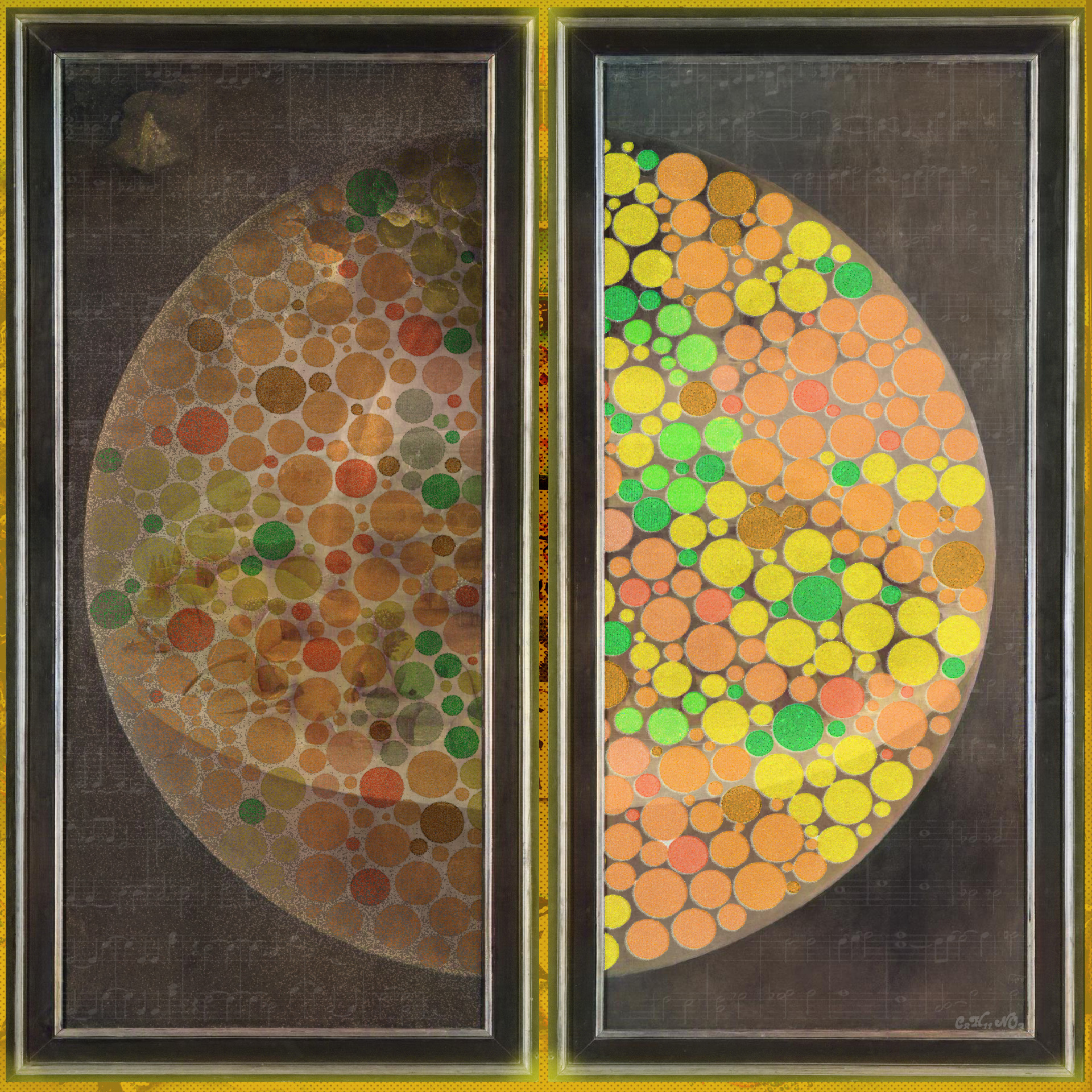
Jhieronymus Bosch by C₈H₁₁ NO₃
Fuller, more accurate, liner notes TK
This [Cabinet of Art and Wonders] is dedicated to Warren Defever.
“Growth in personal collecting of luxury goods by the wealthy in the 1500s, including the small-scaled objects preferred for the Cabinets of Art and Wonders of the time, encouraged sculptors vying for commissions to be inventive [....]” — Joaneath Spicer “European Perceptions of Blackness as Reflected in the Visual Arts” (2012)
There have been multiple attempts to translate the music, or rather the neume-like shapes depicted, in 'The Garden of Earthly Delights' (1495–1505) by Jhieronymus Bosch. With each flawed translation comes new insights into this cultural cabinet of curiosities.
Jheronimus Bosh, born Jheronimus van Aken (~1430–1516), may have been a musician (he is accused of having played the lute). He was well-read, surrounded by music theorists, had an interest in alchemy, and familiar with Christian mysticism groups like The Brethren of the Common Life and Friends of God (that persisted during and beyond The Western Schism). He was a devout member of The Illustrious Brotherhood of Our Blessed Lady, a group promoting the veneration of the Mother of God and the inclusion of polytonal and secular music forms into the Catholic Church. ‘The Garden of Earthly Delights’ (its true title is unknown) was probably created for a secular patron.
Bosch ministered to sufferers of St Anthony’s Fire (ergotism) and may have also suffered a period of illness himself. His depictions of the phantasmagoric include manifestations of symptoms since associated with a variety of diseases like Hysteria (what now falls under a variety of somatization disorders) and The Black Plague (often accompanied by encephalitis or brain inflammation)—all of which can include auditory disturbances.
‘The Garden of Earthly Delights’ is painted as a triptych. The exterior shows a depiction of the third day of creation, with little colour and a ‘flat earth’ within a globe shape surrounding it—even in the middle-ages the idea of a flat earth was long disproven, Columbus had recently proved that the equatorial divide could be crossed, and a variety of by a variety of mappaemundi and globes existed (though the spherical earth was still a theory and occasional subject of dispute within the church).
Once opened 'The Garden of Earthly Delights' is a visual spectacle, but wholly inappropriate for devotional worship. As the context of the painting slowly emerges from discovery and internet cross-references, ‘The Garden’ seems like a painting built for entertainment. While there is no clear narrative, there is travel, action, conflict, beautiful men and women, creatures real and imagined, and an almost too heavy-hand of torture directed towards musicians in hell.
“Think of the endless irony of Hamlet, who when he says one thing almost invariably means another, frequently indeed the opposite of what he says.” — Harold Bloom ‘How To Read And Why’ (2000).
The basis of “Neume Shapes in 'The Garden of Earthly Delights' (1495–1505) by Jhieronymus Bosch” was seeded by the ideas presented by Laurinda S. Dixon and J. Lenneberg via Ian Pittaway’s series of articles on Bosch. Ian Pittaway says this: “Bosch’s message about music and musicians conveyed in The Garden of Earthly Delights and his other works, individually and collectively, all these factors point to the same conclusion: since Bosch painted only the appearance of music, this ‘butt music’ was never intended to be read and played.”
An aside: “On peut regarder voir; On ne peut pas entendre entendre.” — Marcel Duchamp. La Boîte de 1914. 1914
In Purgatory (popular with the Brotherhood), everything is distorted: though music notation did exist at the time, the form was in its infancy and attempts to adapt to polyphonic forms of music from the Ottoman Empire, North Africa and the Far East would have been impossible to adapt; and, if Bosch had been aware of non-European notation systems, impossible to read. And while it’s not impossible that Bosch may have been projecting a series of ‘bombus’ notes understandable to him and his patron, the likelier answer is that the impossibility of reading the notation was the point—and thus part of the joke.
“It was common practice in medieval manuscripts and in renaissance prints to establish the relationship between words and music in the first verse, each syllable underneath its respective note or notes. Since the first verse clarified this relationship, the words of verse two onwards were typically written or printed as a block, separate from the music. [Music notation such as that found in the Gruuthuse manuscript] is entirely separate from the text, so the relationship between text and music is not clear to the reader. It is therefore the case that, just as Strichnotation only works for those already familiar with the music, the Gruuthuse manuscript only works for those already familiar with the songs. As we [can see], it is not the case that Bosch’s ‘music’ is separate from the song words, but that words are completely absent.” — Ian Pittaway “Jheronimus Bosch and the music of hell. Part 1/3: The modern myth of Bosch’s butt music” 2021
"Anyone attempting to adapt these intricate [Coptic] melodies to our Western system of notation finds nuances of pitch and rhythm inherent in this music that simply cannot be indicated accurately." — Marian Robertson-Wilson “Survey of Twentieth-Century Studies of Coptic Music” 2008
Bosc’s tortures are torture, but they are nowhere near as graphic as the central panel. And the musical instruments depicted are completely secular instruments. Curiously absent from the painting is the newer blockwerk pipe organ, an instrument tuned to “octaves, fifths, and thirds.” Bosch definitely knew of the instrument (The archives of the Illustre Lieve Vrouwe Broederschap make mention of an organ in the 14th Century). It was only a few years after the painting’s completion that Henry Niehoff completed the organ at the Cathedral of St. John 's-Hertogenbosch (1533–1540, destroyed by fire in 1584, surviving pipes were re-incorporated into the 1984 rebuild).
“Neume Shapes in 'The Garden of Earthly Delights' (1495–1505) by Jhieronymus Bosch” is intended to be played.
Essential Reading:
1. Anonymous. “Hertogenbosch St. Jan Cathedral Heyeman 1621 organ using older pipes” Pipe Organs. Oct 17, 2010. http://mypipeorganhobby.blogspot.com/2009/11/st-jan-cathedral-organ-in-hertogenbosch.html
2. Balog, Jane. "St. Anthony’s Fire Through the Vision of Hieronymus Bosch: Colloquium." presented towards a B.A. Art History, University of Akron, April 21, 2020 https://youtu.be/RlS-j19q7ho
3. Cormack, Leslie B. “Flat Earth or round sphere: misconceptions of the shape of the Earth and the fifteenth-century transformation of the world” Ecumene, Vol. 1, No. 4 (October 1994), pp. 363-385. Sage Publications, Inc.
4. Demby, Gene. “Taking A Magnifying Glass To The Brown Faces In Medieval Art.” Codeswitch. December 13, 2013. NPR. https://www.npr.org/sections/codeswitch/2013/12/13/250184740
5. Dixon, Laurinda S. “Bosch's Garden of Delights Triptych: Remnants of a ‘Fossil’ Science.” The Art Bulletin, Vol. 63, No. 1 (Mar., 1981), pp. 96-113. Published by: College Art Association.
6. Dixon, Laurinda S. “Bosch’s ‘St. Anthony Triptych”—An Apothecary’s Apotheosis.” Art Journal, Vol. 44, No. 2, Art and Science: Part I, Life Sciences (Summer, 1984), pp. 119-131. College Art Association
7. Doesburg CL. “History and Development of Pipe Organs in the Netherlands. NAG/DAGA 2009, Rotterdam. Hilversum, The Netherlands.
8. Duchamp, Marcel. La Boîte de 1914. 1914. https://philamuseum.org/collection/object/86183
9. Emsheimer, Ernst, and Robert Carroll. “From Earliest Reports about the Music of the Mongols” Asian Music, Autumn - Winter, 1986, Vol. 18, No. 1 (Autumn - Winter, 1986), pp. 1-19 Published by: University of Texas Press Stable
10. Hemphill, R.E. MD, DPM. “The Personality and Problem of Hieronymus Bosch.” Proceedings of the Royal Society of Medicine. 1965;58(2):137-144. doi:10.1177/003591576505800224
11. Jacobs, Lynn F. “The Triptychs of Hieronymus Bosch.” The Sixteenth Century Journal, Winter, 2000, Vol. 31, No. 4 (Winter, 2000), pp. 1009-1041.
12. Lenneberg, J. "Bosch's 'Garden of Earthly Delights': Some musicological considerations and criticisms." Gazette des Beaux-Arts 103 [Sept. 1961] 135-144.
13. Metcalf CS, Huntsman M, Garcia G, Kochanski AK, Chikinda M, Watanabe E, Underwood T, Vanegas F, Smith MD, White HS and Bulaj G. “Music-Enhanced Analgesia and Antiseizure Activities in Animal Models of Pain and Epilepsy: Toward Preclinical Studies Supporting Development of Digital Therapeutics and Their Combinations With Pharmaceutical Drugs.” Front. Neurol. 2019. 10:277. doi: 10.3389/fneur.2019.00277
14. Pittaway, Ian. “A brief history of farting in early music and literature” Early Music Muse. 27 July 2016. https://earlymusicmuse.com/a-brief-history-of-farting/
15. Pittaway, Ian. “Performable music in medieval and renaissance art” Early Music Muse. 19 May 2021.
16. Pittaway, Ian. “Jheronimus Bosch and the music of hell. Part 1/3: The modern myth of Bosch’s butt music” Early Music Muse. 26 May 2021. https://earlymusicmuse.com/bosch1/
17. Pittaway, Ian. “Jheronimus Bosch and the music of hell. Part 2/3: The Garden of Earthly Delights” Early Music Muse. 1 June 2021.
18. Pittaway, Ian. “Jheronimus Bosch and the music of hell. Part 3/3: Music and musicians in the complete works of Bosch” Early Music Muse. 9 June 2021.
19. Robertson-Wilson, M. (2008) Survey of Twentieth-Century Studies of Coptic Music. [Web.] Retrieved from the Library of Congress, https://www.loc.gov/item/ihas.200155642/.
20. Ross, Alex. “The Musical Mysteries of Josquin” The New Yorker 21, June 2021.
21. Valdes, Claudia X. + Phillip Thurtle “Biofeedback and the arts: listening as experimental practice” presented at the REFRESH conference, First International Conference on the Media Arts, Sciences and Technologies held at the Banff Center Sept 29-Oct 4 2005.
22. Young, Liza. “The Rise of the Sentient Musical Instrument: A Study of Hieronymus Bosch's Musical Instruments and their Dissonant Revolution” (2011). Senior Projects Spring 2011. 229. Bard College, Annandale-on-Hudson, NY. https://digitalcommons.bard.edu/senproj_s2011/229
Credits
License
All rights reserved.Tags



You will not find songs here.
Can you navigate the maze?
Excerpts from an ongoing sound collage of neuropathy–induced hyperacusis, dysmetropsia and somatopsychic duality.
Marginalia Vol. IIII